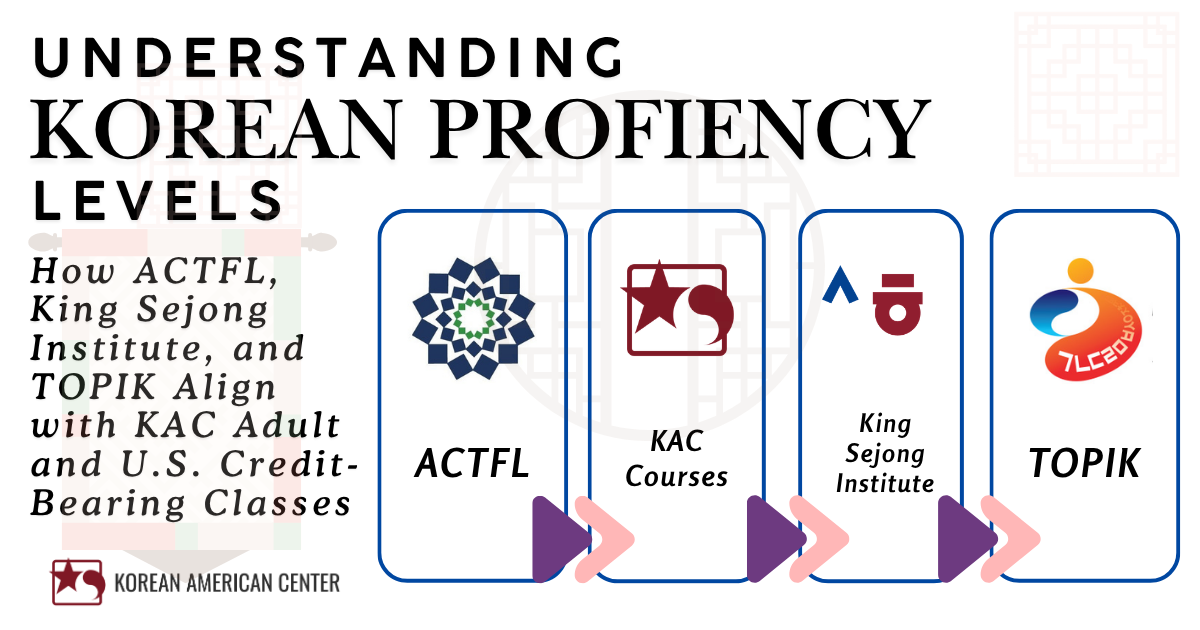
Understanding Korean Proficiency Levels: How ACTFL, King Sejong Institute, and TOPIK Align with KAC Courses
Compare Korean language proficiency systems in one place. See how
A live, accredited Korean course pathway for high school students nationwide, designed to build measurable Korean proficiency. Taught by certified Korean instructors, aligned to ACTFL standards, and supported by official transcripts for school credit or placement review.

KAC’s high school Korean courses are designed to help students build real communication skills, not just complete seat time. Through live instruction, speaking practice, cultural projects, assessments, and feedback, students work toward measurable Korean proficiency while earning transcript-backed coursework their school can review for credit or placement.
Don’t let your school’s course list be the reason your student can’t study Korean. As the only WASC-accredited Korean language institute in the United States, KAC provides official transcripts and documentation your school can review for credit or placement consideration.
KAC provides the accredited coursework, attendance records, grades, syllabus, and official transcript through Parchment. Your student’s school or district makes the final decision about credit. We recommend reviewing the counselor & parent packet with your school before enrolling.
Registration will open soon for Korean 1, Korean 2, Korean 3 Honors, and Korean 4 Honors. New cohorts begin every 8 to 10 weeks.
Live online classes with multiple time options available to fit your schedule.
Approximately 150 hours of live instruction and academic support, structured coursework, assessments, teacher feedback, and an official transcript documenting a full year (1.0 credit) of study.
Each level is a full academic year worth 1.0 credit, with approximately 150 instructional hours through live classes, lab, assignments, and instructor-led activities. Korean 3 and Korean 4 are honors levels. Every course is designed around ACTFL proficiency goals, so students move from basic communication to more independent reading, writing, listening, and speaking as they progress from Korean 1 through Korean 4. Your student’s school decides how the credit is accepted or applied. Official transcripts are issued through Parchment.
Designed for students with little or no prior experience in Korean. Through communication-focused instruction, comprehensible input, cultural exploration, and project-based learning, students learn to read and write Hangul, exchange greetings, and ask and answer basic questions, then build toward more detailed sentence structures, polite and formal speech, sequential actions, describing experiences, expressing reasons, and discussing past and future events. By the end of the year, students can handle real-world tasks such as giving directions, scheduling appointments, and talking about personal progress.
Standard Pace: Classes start the week of January 4, 2027.
Introduces essential Korean communication patterns and grammatical structures, moving learners from Novice High toward Intermediate Low proficiency. Students handle straightforward social situations, understand main ideas from authentic texts and audio, and initiate, sustain, and close conversations. Using culturally appropriate honorifics, they describe daily routines, intentions, travel, weather, and sequences of events through cohesive paragraphs and media projects, guided by the ACTFL 5Cs.
An honors-level course for students who have demonstrated Novice High proficiency and are ready to move from isolated words and phrases to creating with the language. Through high-frequency thematic units and performance-based assessments aligned with national world language standards, students manage daily social dynamics: planning events, shopping, expressing personal aspirations, negotiating relationships, and understanding nuance in casual versus formal interactions.
An honors-level advanced course for students ready to move from simple, predictable tasks to complex, paragraph-length communication: expressing abstract thoughts, defending opinions, analyzing authentic cultural texts, and resolving unexpected complications in spontaneous interactions. The course emphasizes the intersection of language and culture, including nuanced social etiquette, idioms, and cultural context on historical and social topics.
$2,398 per level for the full academic year: 1.0 credit and approximately 150 instructional hours. New cohorts begin every 8 to 10 weeks.
Credit or placement is granted at your school’s discretion. We provide the official Parchment transcript and supporting documentation for your counselor to review.
Most students should begin with Korean 1. Students who have completed Korean courses for academic credit at their middle or high school may continue into the appropriate next course, including Korean 3 or 4, based on their previous coursework and school records. Students whose prior Korean study was through a private or for-profit language institute must complete KAC’s placement assessment and submit the institute’s curriculum for review. Heritage learners and students with Korean experience but no formal academic coursework should either start in Korean 1A to improve reading and writing or complete the placement assessment before enrolling.
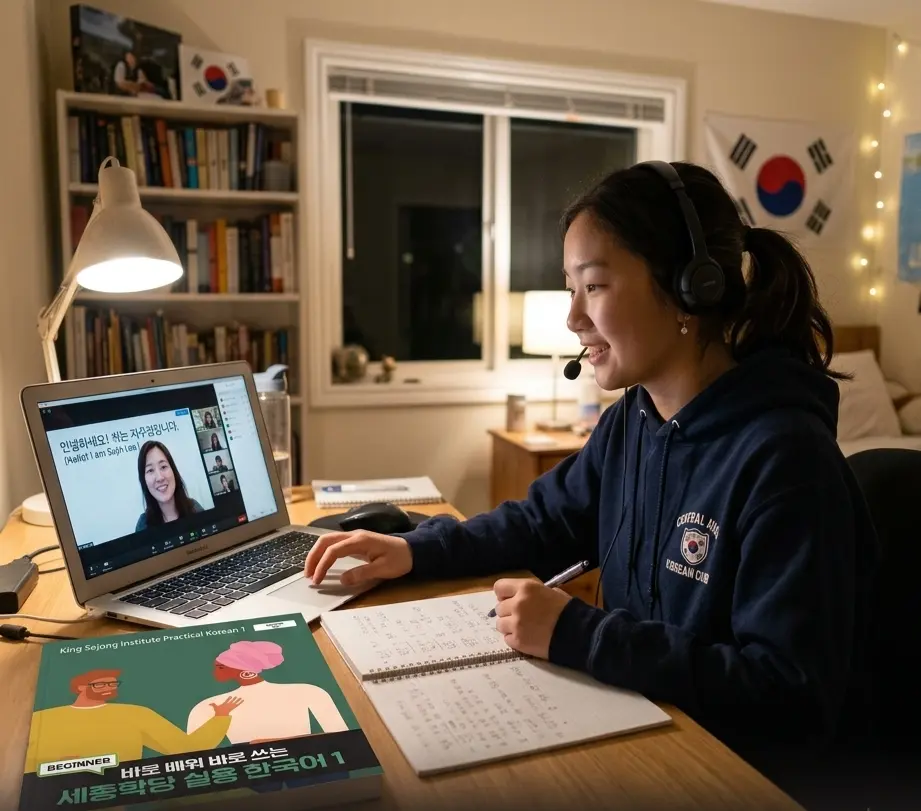
Students attend scheduled live classes with a Korean instructor and classmates, not prerecorded videos or a self-paced app. Each course follows the same academic rhythm: two live classes a week, a weekly lab, ongoing assignments, and a final ACTFL-aligned project, with grades and progress documented for the official transcript.
Accreditation means educational quality, accountability, and alignment with U.S. school systems.
KAC provides attendance records, grades, syllabus, course details, and an official transcript through Parchment for school credit or placement review.
Designated by the South Korean government to teach Korean in the U.S. as a King Sejong Institute. KAC is fully focused on Korean language and culture, with curriculum, assessments, and teacher training built specifically for Korean learners.
Courses are built around nationally used proficiency standards, so students are assessed on what they can actually understand, say, read, and write in Korean, not just what grammar rules they've memorized.
Students learn Korean through culture, history, etiquette, media, food, and modern life, with projects that connect language to real-world use.
Students learn from KAC-vetted, experienced U.S.-based educators trained to teach Korean as a foreign language, with ongoing professional development. KAC does not outsource to instructors overseas.
A KAC education goes beyond a high school transcript, opening doors on both sides of the Pacific.
Delivered through the King Sejong Institute, established by South Korea’s Ministry of Culture, Sports, and Tourism.
Recognized by Korean universities and employers, alongside your official U.S. transcript.
Builds toward NEWL (recognized in the U.S.) and TOPIK/SKA (recognized in Korea).
Support toward the California State Seal of Biliteracy on the high school diploma.
Documentation and an official Parchment transcript your counselor can use for credit or placement.
Unique study-abroad and cultural immersion experiences in Korea.
Everything a counselor needs to evaluate credit: level and credit structure, attendance policy, make-up rules, transcript and Parchment details, and enrollment steps.
Many districts grant credit or placement for accredited outside language study when a language isn’t offered at their school. We provide an official transcript through Parchment plus documentation for your counselor to review. Final approval is up to your school.
No. The Global Seal of Biliteracy is a privately issued certificate, not a government credential, accreditation, academic credit, or professional license. It is operated by Global Seal of Biliteracy, LLC. It was founded and sponsored by Avant Assessment, a company that sells assessment tests. Students must qualify through their language assessment, and the seal primarily repackages the proficiency level already documented by that assessment. It is not recognized by Korean colleges or employers.
For this reason, KAC does not treat the Global Seal as a separate educational achievement or use it to market our Korean language programs. We focus on what matters: whether students can actually understand, speak, read, and write Korean. The ability to use Korean is the most meaningful proof of Korean proficiency.
Students interested in California’s official State Seal of Biliteracy should contact their public high school or school district, as that is a separate state-administered recognition.
Many do when a language isn’t offered at the school. We provide the transcript and documentation your counselor needs.
Not at this time. KAC classes are taught live because learning to communicate in Korean requires more than watching lessons and completing assignments independently. Students need regular opportunities to speak, listen, ask questions, interact with others, and receive immediate feedback on pronunciation and language use.
Recorded lessons can be helpful as a supplement, but they do not replace the active participation and consistent interaction needed to build real proficiency. Our live online classes provide the structure, accountability, and speaking practice students need to make meaningful progress.
No. KAC does not outsource the decision about whether a student has successfully completed our course. We are experts in Korean language education. We have the curriculum, qualified instructors, academic standards, and assessment systems necessary to evaluate our own students.
Students are assessed throughout the course through assignments, quizzes, oral and written performance tasks, projects, exams, participation, and demonstrated progress toward established learning outcomes. This sustained body of work provides a far more complete picture of a student’s learning than a single test administered by an outside organization.
Credit is not automatic. Students must meet class requirements, complete required coursework and assessments, and earn a passing grade. However, they do not need to pay for or travel elsewhere to take a third-party exam before KAC will recognize the work they completed with us.
We know what our students have been taught, we evaluate what they can do, and we stand behind our curriculum, our instructors, and our assessment process.
Absolutely. Our courses build proficiency that can support preparation for the NEWL Korean exam, whose scores may be considered for college placement or credit depending on the institution.
Limited make-ups plus documented alternative tasks; attendance policy included in packet.
Yes we do.
We’ll do our best to accommodate changes early in the term, subject to seat availability.
Yes. Our classes welcome students of every background, including complete beginners with no Korean at home.
We offer Korean 1 through Korean 4. Each level represents one full academic year and is divided into two semester courses: Part A and Part B.
Each course is worth 0.5 high school credit and includes 60–75 instructional hours through live classes and a weekly lab. Students who successfully complete both Part A and Part B earn 1.0 credit for the full level.
New cohorts may begin at different points throughout the year as space allows. Regardless of the start date, every student must complete the full course to earn credit and qualify for an official transcript.
Official transcripts are issued through Parchment, so you can send verified records directly to your school or district.
Heritage learners and students who speak or understand some Korean but have not completed formal academic coursework may begin with Korean 1A to strengthen reading, writing, and grammar skills or complete a placement assessment before enrolling.
Students who have completed Korean for academic credit at a middle or high school may continue into the appropriate next course, including Korean 2, 3, or 4, based on their transcripts, course records, and prior curriculum.
Students whose previous Korean study was completed through a private or for-profit language institute must take KAC’s placement assessment and submit the institute’s curriculum or course materials for review.
Yes. KAC welcomes opportunities to establish articulation agreements with schools and districts that want their students to complete Korean language coursework through KAC. KAC is also open to discussing dedicated cohorts, institutional partnerships, and pre-negotiated program rates. Please contact us at: [email protected]
Korean 1 through Korean 4 Honors is now open for registration. Review the pathway, choose a pace, and register.
Learn Korean. Experience Culture. Connect with Community. From our roots in Orange County, California to learners everywhere, our accredited Korean language and culture programs bring expert teaching and cultural connection online and in person.
Compare Korean language proficiency systems in one place. See how
With BTS bringing Korean language and culture to global audiences,
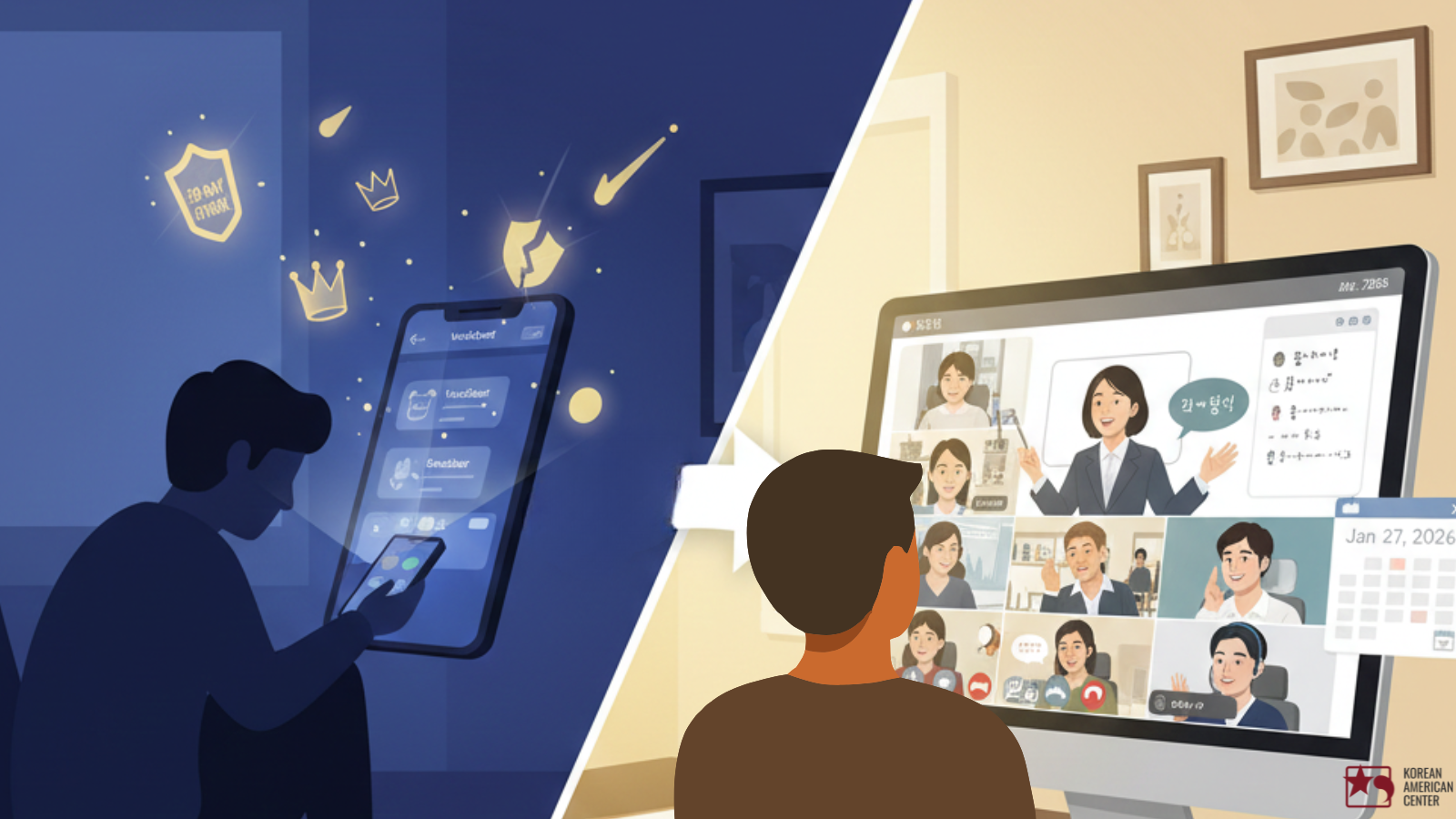
From App Dabbler to Dedicated Student After 30 days of

Following the Korean War, South Korea transformed from a war-torn