
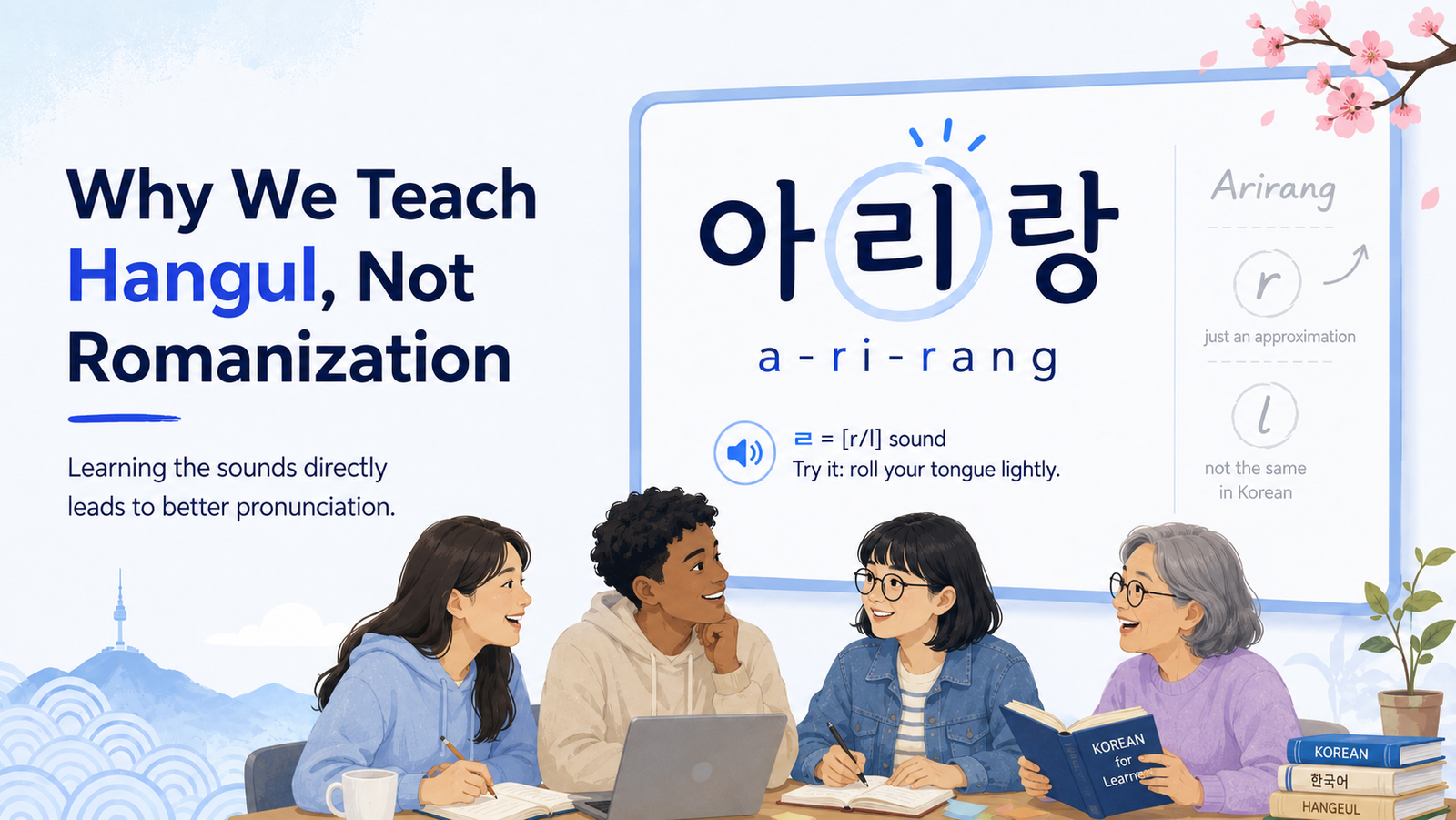
With BTS bringing Korean language and culture to global audiences, words like Arirang (아리랑) have become familiar even to people who have never studied Korean. If you have been learning Korean through romanization, spelling Korean words with English letters, you are not alone. But here is the problem: reading Korean through English letters can easily lead you to the wrong pronunciation, and the longer you rely on it, the harder it becomes to correct.
At Korean American Center, one of the longest-running adult Korean language programs in the United States, we have worked with more than 10,000 learners. One of the most consistent things we have seen is this: if you learn Korean through romanization early on, you develop pronunciation habits that are significantly harder to fix later. This is not a theory. It is something we have observed across learners of every background and age, over more than a decade of teaching.
That is why we teach you to learn Hangul sounds directly. We may offer a brief Roman letter guide with Hangul at the very beginning, but Romanization is only a temporary bridge. It is not the goal.
For many years, Korean was commonly taught through Romanization. Learners read Korean words using English letters instead of developing a real relationship with Hangul. It may feel easier at first. But our research shows it creates a ceiling, one that limits how accurately you can eventually hear, read, and speak Korean.
A clear example is Arirang (아리랑). The Korean letter “ㄹ” is often romanized as “R” or “L”, but it is neither. Linguists classify it as an alveolar flap, a light, quick tap of the tongue, similar to the Spanish “R”, but distinctly Korean. So if you are pronouncing 아리랑 (Arirang) like:
- AH-REE-RANG (like “rang a bell”)
- AH-LEE-LANG (with a hard L, like “language“)
you are not alone, but you are also not quite there yet. No English spelling can capture that sound accurately. The only way to truly learn it is to hear it, practice it, and connect it directly to the Korean letter.
Even the word Hangul (한글) illustrates this problem. Its standard spelling, Hangeul, comes from the Revised Romanization of Korean, the official system adopted by the South Korean government in 2000, and even that spelling trips up English speakers. Neither version teaches you the actual Korean sound. That is not a failure on your part. It is simply the limit of what English letters can do with Korean sounds.
This is why we do not provide romanized guidance for full Korean sentences. Romanization can become a crutch. It feels comfortable at first, but over time, it quietly works against your progress. Our goal is not for you to sound out Korean through English. Our goal is for you to read Korean as Korean.
This may feel unfamiliar right now, and that is completely normal. Learning a new writing system takes patience. But Hangul was designed to be logical and learnable, and what our research shows, consistently, is that once you grow comfortable with it, your pronunciation, listening, reading, and confidence all improve together.
When we ask you to learn the sounds of Hangul, we are not making learning harder. We are giving you the foundation that actually works.
That starts with Hangul, not romanization.
Korean American Center is one of the longest-running adult Korean language programs in the United States, drawing on the experiences of more than 10,000 students to shape how we teach.