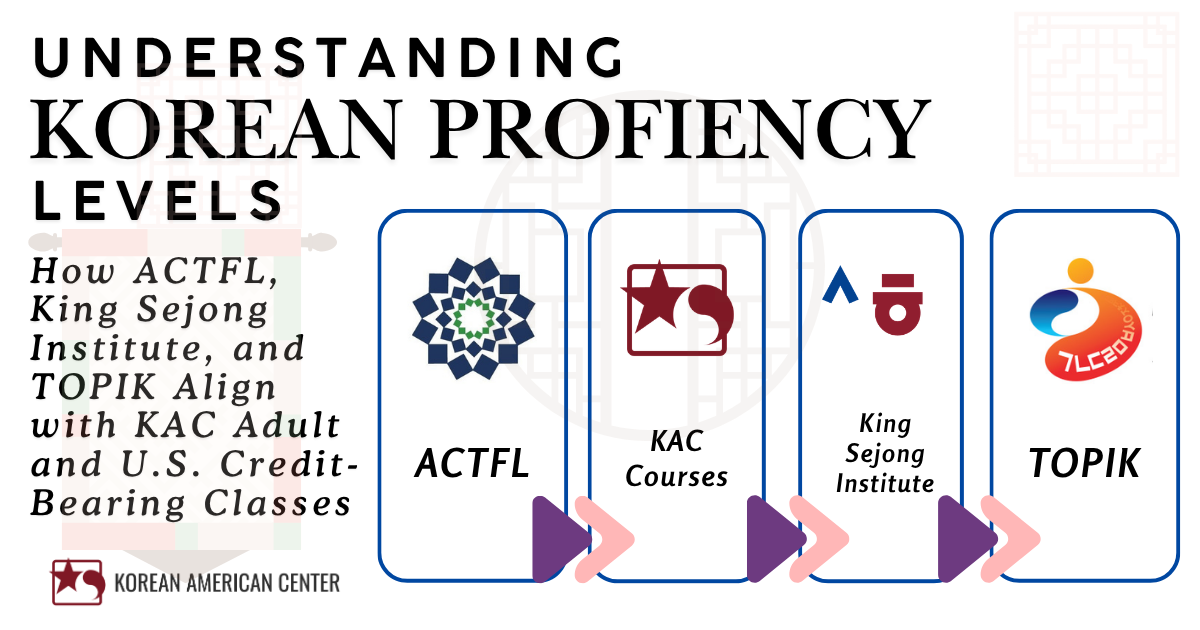
New students and families run into four different ways of talking about progress in Korean: ACTFL proficiency levels, U.S. credit-bearing high school courses, King Sejong Institute levels, and TOPIK scores. Each comes from a different organization and answers a different question. Here’s what each one measures and how they connect across KAC’s course sequence.
What Each System Measures
ACTFL Proficiency Levels
ACTFL is the standard used in U.S. world language education, and it’s the proficiency foundation behind KAC’s credit-bearing high school program. ACTFL proficiency levels describe what a learner can consistently do with Korean; what the learner can understand, say, read, and write in spontaneous, real-world situations. ACTFL proficiency is based on demonstrated ability, not simply the completion of a course or textbook.
The ACTFL scale progresses from Novice through Distinguished, with most levels divided into Low, Mid, and High. KAC’s current high school course sequence spans Novice through Advanced.
U.S. Credit-Bearing Courses
KAC’s high school Korean program follows the King Sejong Institute curriculum and layers in ACTFL standards, with instructional hours structured to the Carnegie unit, the standard measure U.S. schools use to award course credit. Each full high school level runs about 150 instructional hours across Part A and Part B, letting students move through the KSI curriculum faster while going deeper through live instruction, assignments, assessments, and practice across speaking, listening, reading, and writing.
Korean 1 through Korean 4 Honors track the proficiency growth that U.S. schools and colleges expect at each stage of world language study. Together, Part A and Part B earn one Carnegie unit of world language credit.
Korean Standard Curriculum and King Sejong Institute Levels
South Korea’s national framework for Korean-language education comes from the Korean Standard Curriculum, developed by the National Institute of Korean Language. It sets shared proficiency goals and achievement standards for listening, speaking, reading, and writing.
The King Sejong Institute Foundation builds on that framework to develop and manage the curriculum taught at King Sejong Institutes worldwide, including a standardized Basic Curriculum and specialized courses institutes can add based on local needs. Institutes also have latitude to structure instruction around their local setting.
Korean American Center is a designated King Sejong Institute and operates as KAC’s Irvine King Sejong Institute Program. Its Core Korean Program follows the KSI curriculum on a schedule built for adult learners in the U.S.
Core classes meet once a week for two hours over a 10-week term. KAC breaks the broader King Sejong Institute curriculum into smaller stages:
- Korean Fundamentals
- Beginner 1–6
- Intermediate 1–6
- Pre-Advanced 1–2
Because of this pacing, one King Sejong Institute level can stretch across more than one KAC class. Students who meet KAC’s attendance, assessment, and curriculum-completion requirements can earn an official King Sejong Institute certificate for the applicable Sejong level. A KSI certificate documents study through a designated King Sejong Institute and can support educational or employment applications, as well as certain Korean visa categories.
TOPIK
TOPIK, the Test of Proficiency in Korean, is a standardized exam, not a curriculum or course level. Scores can factor into university admission and graduation, employment, scholarship applications, and certain immigration or residency processes in Korea.
The exam has two categories:
- TOPIK I: Levels 1 and 2 (1급 and 2급)
- TOPIK II: Levels 3 through 6 (3급 through 6급)
KAC doesn’t administer TOPIK or award TOPIK levels. In KAC’s alignment chart, the TOPIK column shows the test level a student may be prepared to attempt after completing the corresponding KAC coursework and building the expected skills. Finishing a course doesn’t guarantee a particular score. Students still need to prepare for the exam’s format, timing, question types, and vocabulary demands.
How the Levels Align
| KAC Core class | ACTFL Proficiency Level | KAC high school course | Approximate Sejong level | TOPIK goal |
| Korean Fundamentals | Novice Low | Korean 1 | Sejong 1A | Foundational preparation |
| Beginner 1 | Novice Mid | Korean 1 | Sejong 1A | Foundational preparation |
| Beginner 2 | Novice Mid–High | Korean 1 | Sejong 1A–1B | TOPIK Level 1 |
| Beginner 3 | Novice Mid–High | Korean 1 | Sejong 1B | TOPIK Level 1 |
| Beginner 4 | Novice High | Korean 2 | Sejong 2A | TOPIK Level 1 |
| Beginner 5 | Intermediate Low | Korean 2 | Sejong 2A | TOPIK Level 2 |
| Beginner 6 | Intermediate Low | Korean 2 | Sejong 2B | TOPIK Level 2 |
| Intermediate 1 | Intermediate Mid | Korean 3 | Sejong 3A | TOPIK Level 3 |
| Intermediate 2 | Intermediate Mid | Korean 3 | Sejong 3B | TOPIK Level 3 |
| Intermediate 3 | Intermediate Mid | Korean 3 | Sejong 4A | TOPIK Level 3 |
| Intermediate 4 | Intermediate Mid–High | Korean 4 Honors | Sejong 4B | TOPIK Level 3 |
| Intermediate 5 | Intermediate High | Korean 4 Honors | Sejong 4B | TOPIK Level 4 |
| Intermediate 6 | Intermediate High | Korean 4 Honors | Sejong 5A | TOPIK Level 4 |
| Pre-Advanced 1 | Advanced Low | Korean 4 Honors | Sejong 5B | TOPIK Level 5 |
| Pre-Advanced 2 | Advanced Low | Korean 4 Honors | Sejong 6A/B | TOPIK Level 6 |
How KAC’s Core and High School Programs Differ
Both programs follow the King Sejong Institute curriculum. What differs is structure and depth.
Core classes run two hours a week over a 10-week term, roughly 20 instructional hours per class. That pace spreads the Sejong curriculum across Korean Fundamentals, Beginner 1–6, Intermediate 1–6, and Pre-Advanced 1–2.
The high school program moves faster and goes deeper. Each full level runs about 150 instructional hours across Part A and Part B, and adds:
- ACTFL World-Readiness Standards and proficiency expectations
- Instructional hours structured to the Carnegie unit, the standard measure of world language credit
- Academic assignments and assessments
- More extensive speaking, listening, reading, and writing practice
- Defined outcomes for U.S. high school world language credit
Because of the added instructional time and pace, one high school level covers the proficiency ground of several Core classes:
| KAC high school course | Related KAC Core classes | Approximate ACTFL range |
| Korean 1 | Korean Fundamentals–Beginner 3 | Novice Low–Novice Mid/High |
| Korean 2 | Beginner 4–Beginner 6 | Novice High–Intermediate Low |
| Korean 3 | Intermediate 1–Intermediate 3 | Intermediate Mid |
| Korean 4 Honors | Intermediate 4–Pre-Advanced 2 | Intermediate Mid/High–Advanced Low |
Both programs share the same KSI foundation. The high school program adds the instructional hours, rigor, assessments, and proficiency benchmarks required for U.S. high school credit. Students entering above Korean 1 may need a placement assessment covering speaking, listening, reading, writing, vocabulary, and grammar.
Why TOPIK and ACTFL May Show Different Results
ACTFL and TOPIK measure different things. ACTFL looks at how a learner uses Korean across listening, speaking, reading, and writing in real communication. TOPIK I covers listening and reading; TOPIK II adds writing. Neither level of the standard TOPIK exam assesses speaking directly.
A student with strong grammar, vocabulary, reading skills, and test-taking ability can score well on TOPIK while still needing more practice with spontaneous conversation. A heritage learner might speak comfortably but need more work on reading, writing, formal grammar, or the TOPIK format itself. The two systems give complementary information, not competing ones.
Why This Alignment Matters
KAC’s alignment framework gives students, parents, school counselors, and other institutions a clear reference point. Looking up a KAC class shows:
- The ACTFL proficiency range the class targets
- The related KAC high school credit course
- The corresponding place in the King Sejong Institute curriculum
- The TOPIK level a student may be working toward
This supports high school credit articulation, helps adult learners see where they stand in the Sejong curriculum, and gives TOPIK-bound students a realistic testing goal.
A Roadmap, Not a Guarantee
The alignment chart is a guide, not an exact conversion formula. Each system answers a different question:
- KAC Core class: Where is the learner within KAC’s 10-week sequence?
- KAC high school course: Has the student met the academic requirements for a U.S. credit-bearing Korean course?
- ACTFL: What can the learner consistently do with Korean?
- King Sejong Institute: Where is the learner within the KSI curriculum?
- TOPIK: What level has the learner demonstrated on a standardized exam?
Students develop at different rates. Attendance, participation, prior exposure to Korean, independent practice, and real-world opportunities to use the language all shape progress, and a student’s speaking, listening, reading, and writing levels can differ.
The chart is a practical way to see how KAC’s classes connect with recognized Korean-language and U.S. education frameworks. The most meaningful measure of progress isn’t a course title, a certificate, or a test score. It’s what the learner can understand and communicate in Korean.